
Speculate responsibly.
And be positively ready for things to go sideways.
Trust is a hopeful state. But what about risk? And the risk in trust — of other people, of institutions, of belief systems? Even when trying to do the right thing is the primary source of motivation, we learn very quickly that not every colleague or partner shares it. The act of trusting them, or the system in which we work together, turns into an exercise of calculating risk. To get to trust, we must get to courage first — because we are going to run into every kind of crazy in life and in work. The base condition of being ready to tackle the crazy as well as the cool — courage — frees a person to focus, in every situation, on the facts, not only the hope, not merely the possibility.
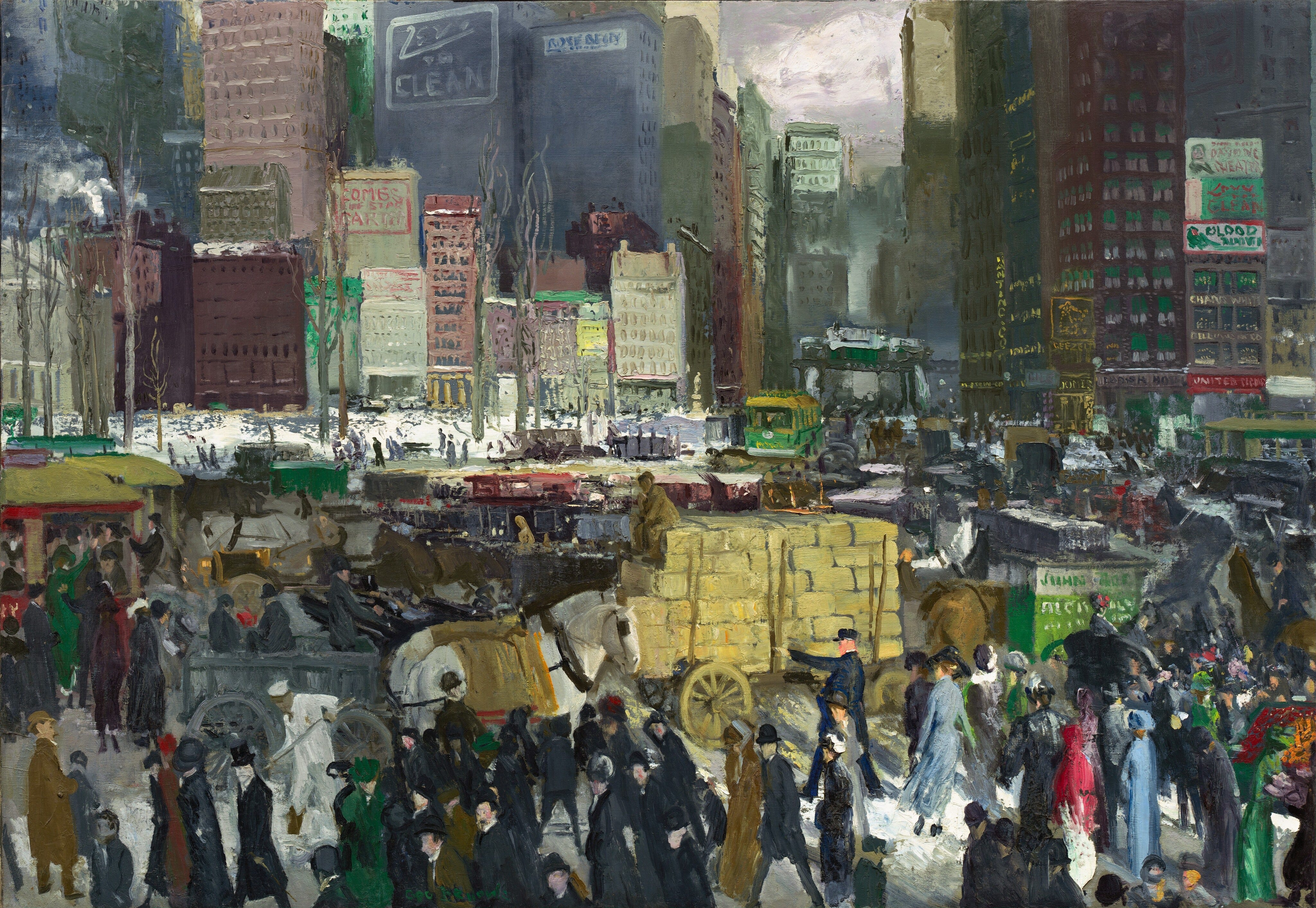
New York. George Bellows. 1911. Oil on canvas. Collection of Mr. and Mrs. Paul Mellon. National Gallery of Art.
The risk that built America
Andrew Ross Sorkin. They believed American capitalism was entering a new phase, powered by the masses. They were wrong about many things: how much leverage was safe; how markets behave under stress; what happens when charlatans, including some running these institutions, manipulate the system. But they weren’t wrong about the importance of speculation. … The lesson of 1929 is not “don’t speculate.” The lesson is: Speculate responsibly.
Seeing business like a language model
Dan Shipper. This is why business principles are simultaneously useful and dangerous. They help us make sense of patterns we observe, but the moment we treat them as universal laws, we become blind to what makes them work or fail in any given situation. The key is not to abandon principles entirely, but to hold them loosely—always ready to notice anomalies that signal the game has changed.
What chickens can teach us about the too-much-talent problem
Jon Levy. As awful as the chicken coop may sound, the lesson applies directly to the workplace. Too many companies operate like farms full of Dekalb XLs, rewarding individuals who hit their own numbers, even if they damage everyone around them. From school onward, we are groomed for competition: ace the tests, get into the right college, land the best internships, climb faster than our peers. By the time we are in business, many of us have internalized the same destructive logic as those super chickens: my success depends on your failure.
The mystery of one of Italy’s most iconic pastas
Kaitlyn Rosati. There are a few variations of the myth, but the most popular version goes like this: Venus, Bacchus and Mars walk into an inn in Castelfranco Emilia. The following morning, Venus is sleeping naked and alone, and the innkeeper, infatuated with her beauty, peeps through the keyhole and sees her exposed belly button. Inspired by its shape, he creates tortellini.